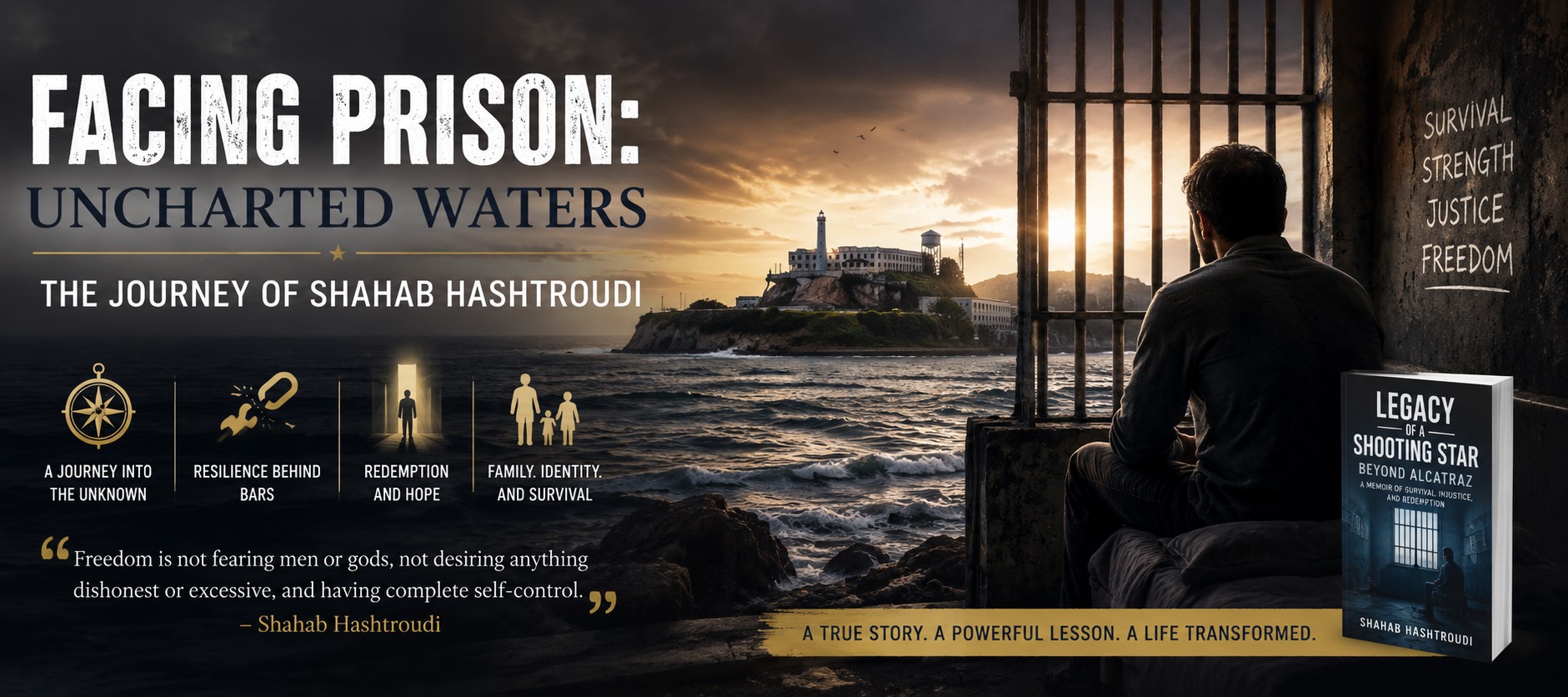
The idea of going to prison is life-altering for anyone. For someone unfamiliar with the criminal justice system, it is like preparing for an unexpected voyage into vast, uncharted waters without a compass or map. A slight deviation in navigation can lead to a safe harbour… or to disaster. When the people and government are united, they create an unstoppable force to save a nation, a society weary of so many injustices and acts of arbitrariness. Unknowingly, by fighting for justice, confronting his own fears, and reaching out to those who ask for support, he will build the bridge and create the social foundations to resist extinction.
A Memoir of Survival and Identity
“Legacy of a Shooting Star: Beyond Alcatraz” by Shahab Hashtroudi of a Shooting Star
Sahab Hashtroudi is a powerful memoir that traces the author’s journey from Tehran to a British prison. Once a successful entrepreneur, Shahab faces an unjust justice system that tests his spirit and identity. The interests created by previous rulers place obstacles in the path of justice and continue to prosper at the expense of the people’s suffering, but they will eventually be the first to fall under relentless justice.
Resilience, Hope, and Redemption Behind Bars
Through vivid memories of his family’s turbulent history in Iran and his own struggle for dignity behind bars, the real-life story of “Legacy of a Shooting Star: Beyond Alcatraz” becomes a testament to resilience, hope, and redemption. The narrative is a journey through solitary confinement and is marked by hardships: a long and arduous path filled with obstacles, but one that can be overcome with perseverance and determination. Written with honesty and depth, the book explores how personal strength and humanity can survive even in the harshest circumstances, offering an inspiring testament to enduring injustice and discovering freedom within.
Learning and Reform: Shahab Hashtroudi’s Call

No one who enters prison should allow that experience to define their entire life. Instead, it is crucial to prepare strategically. By openly sharing his journey, Hashtroudi allows us to highlight the valuable lessons he learned during incarceration and to advocate for vital reforms in our prison system. Hashtroudi believes we should reserve prisons for people who pose a genuine threat to society. We should incentivise those individuals to work towards earning greater freedom on their own merits. If people should not be behind bars, we should offer them opportunities to work towards home confinement or work-release schemes.
You ask what freedom is? Freedom is not fearing men or gods, not desiring anything dishonest or excessive, and having complete self-control.
Freedom Found in Captivity
Being in prison gave Hashtroudi a new and addictive sense of freedom—one he discovered gradually, and which he sought to share with you through these chapters. He speaks of the freedom that comes from relinquishing the desire for many material things that once held him captive. It is the freedom you discover in a cell when you manage to silence the desperate and foolish voices that nest inside you, the freedom that washes over you each time you manage to better align your way of thinking, feeling, and acting.
We mistakenly conceive of freedom as a space where we can do whatever we want. And prison is a good place to discover that the space outside these walls, where everything is possible, can also be an ambush.
Unplug From Autopilot.
Life is what happens between these two deceptive ideas:
“The best is yet to come,” and “The past was always better.”
Before going to prison, Hashtroudi lived on autopilot, constantly focused on the next stage, the next appointment, the next conversation, the next trip, tomorrow, next week… When he went to prison, everything stopped, yet Hashtroudi was enveloped by another kind of inertia, one much more painful. He tried to escape the reality surrounding him and remained sheltered in my memories or in longings for life in freedom. When you’re in prison, the last thing you want to do at first is enjoy the moment. However, with time, you begin to learn to make a virtue of scarcity, to pay attention and let yourself be surprised by the things in front of you. You learn to pay a new, more sensitive attention. Suddenly, you see life as an hourglass, and you realize that life is, above all, the sand that slides, not the sand that has already fallen or the sand that remains to fall, and then you concentrate, you become absorbed, you stop at that tireless and sandy waterfall in which life happens.
You’re Going To Score.
Your expectations of yourself determine your success. Have you heard of the Pygmalion effect? According to Greek mythology, Pygmalion, King of Cyprus, searched for a long time for a woman to marry; however, this woman had to be perfect. Unable to find her, he began creating sculptures that would achieve his ideal of beauty. Finally, he managed to sculpt a figure so beautiful that he fell madly in love with her and named her Galatea. One night, he dreamed that Aphrodite transformed herself into a person of flesh and blood, and upon waking from the dream, Aphrodite remained there, moved by Pygmalion’s intense desire, and said to him:
“You deserve to have your wish fulfilled, you deserve happiness, a happiness that you yourself have created. Love it and defend it from evil.”
When we have a purpose, we must “love it and defend it.” Having a purpose, turning it into an expectation, visualizing it, writing about it, living it, going to bed and waking up with it every day, inevitably brings you closer to it. It makes you a more competitive warrior in the fight to achieve it. We must believe in our ability to achieve what we want; we will hardly succeed.
The Power of Self-Belief
If you are going to take a shot at basketball and you manage to get your inner voice to speak firmly to you, saying, “You are going to make it, you are going to make it, you are going to make it…” you might not succeed, but the probability of success will undoubtedly be much greater than if there were no voice or conviction. Of course you can! Do not stop repeating it to yourself.
From Adversity to Acceptance
Prison is something that can be overcome; it can even become an enriching experience. Stop asking yourself “Why me?” and start asking yourself “Why not me?” or “What purpose does this serve?” Only in this way will you find the meaning, sometimes elusive, of what has happened to you; only then will you discover that hidden beauty adjacent to adversity.
Embracing Vulnerability: Lessons from Hashtroudi
Do not be afraid to show your vulnerability. Hashtroudi is not talking about complaining; he is talking about asking for help, seeking forgiveness, blushing, and crying. We trust those who do not hesitate to show their feelings more, especially when we are speaking of the people we care about, those we trust, and those in our emotional support network.